
by Mike Savage
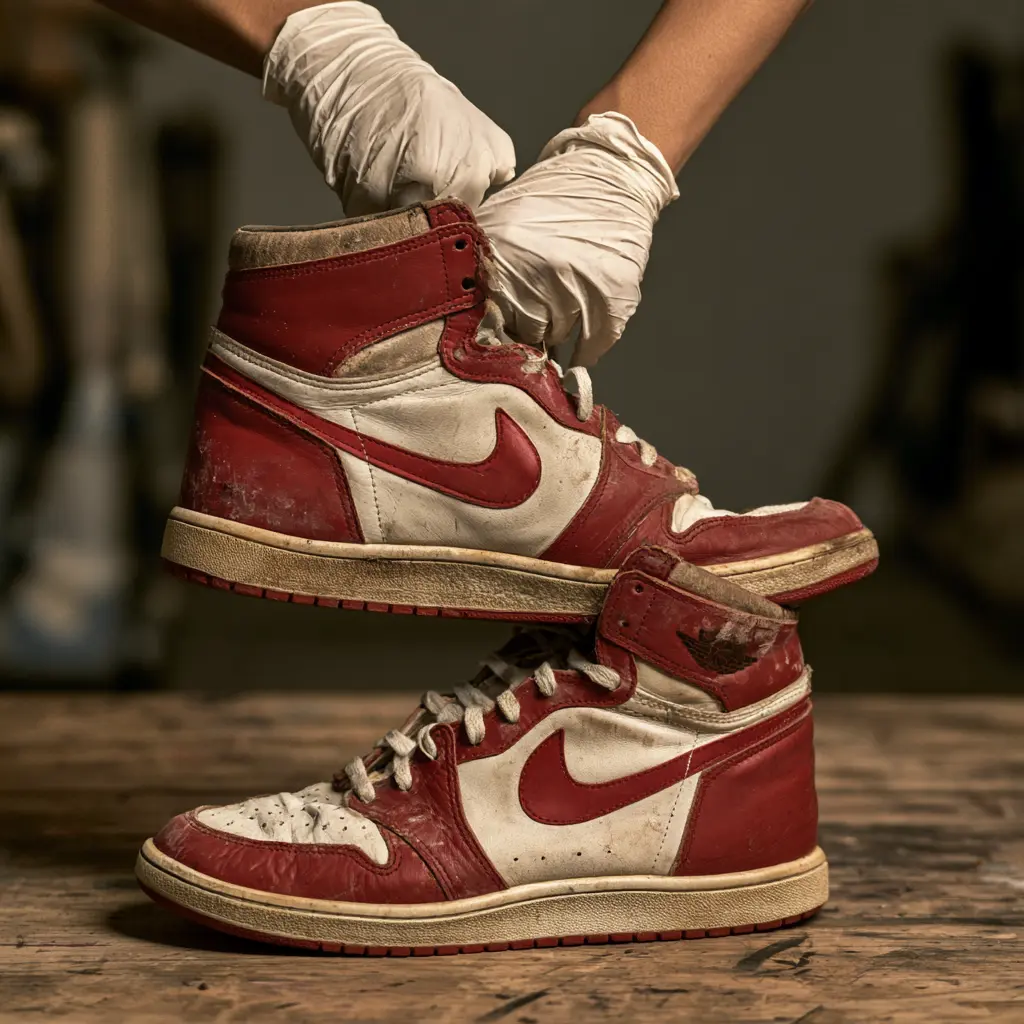
The first time it happened to me, I did everything right and still lost the shoe. It was a pair of Air Jordan IVs I had kept boxed for years, stuffed with tissue, out of the sun, in a closet that never saw a humid day. I took them out on a cool October afternoon to photograph them, pressed my thumb gently into the heel, and felt the midsole give way like a stale cookie. A fine yellow-white dust fell onto the floor. The uppers were perfect. The shoe was finished.
Every serious sneaker collector has a version of that story, and most of us remember exactly where we were standing. It is a strange grief, because nothing dramatic happened. No one wore them in the rain. No dog got to them. Time simply did what time does, and a piece of foam that was engineered for a basketball court in 1989 quietly came apart on a shelf in Connecticut.
That moment changed how I collect. I stopped thinking of my shoes as finished objects and started thinking of them as materials with a clock running inside. This month I want to talk about that clock: why vintage sneakers crumble and yellow, what the museum world has learned about the same problem, and when restoration, including the controversial sole swap, is the right call for a collector who cares about both history and value.
The Material Problem Nobody Warns You About
When people ask me why a shoe that was never worn can fall apart, I explain that the answer is chemistry, not care. Many of the most beloved Air Jordans from the late 1980s and early 1990s, the III, IV, V and VI in particular, were built with polyurethane midsoles. Polyurethane was a smart choice for performance. It is resilient, it can be molded around an Air unit, and it gave those shoes the cushioning and stability that made them famous on the court.
The trouble is that polyurethane does not age gracefully. The main culprit is a reaction called hydrolysis, in which moisture in the air slowly breaks down the chemical bonds that hold the foam together. It happens whether the shoe is worn or not, and in some ways a shoe sitting in a box is more vulnerable, because it never gets the compression and airflow that wearing provides. Over the years the foam hardens, cracks, and eventually crumbles. The paint on the midsole often flakes off first, which is why a cracked midsole is usually the earliest visible warning.
The second problem is oxidation, which shows up as yellowing. Anyone who has watched an icy translucent outsole turn the color of weak tea knows what I mean. Clear and white rubbers and foams react with oxygen and ultraviolet light, and the change is gradual enough that you often do not notice until you set an old pair next to a new one.
I wrote about the preservation challenge in broad terms in my piece on documenting sneaker history and archiving collectible footwear. This time I want to go deeper into what actually causes the damage and what we can do about it.
What Museums Already Know
One of the most reassuring things I learned is that sneaker collectors are not alone. Museum conservators have been fighting the same battle with plastics for decades. The Getty Conservation Institute, which runs a dedicated Preservation of Plastics research effort, has described polyurethane as “one of the most problematic plastics in museum collections,” because of how it reacts to light and humidity. In a Getty News feature on preserving plastic fashion, conservators note that synthetic materials like polyurethane “can crack, dissolve into crumbs, weep out additives, or melt into sludge,” and that some vintage fashion pieces can no longer be displayed at all.
That sentence stopped me cold, because “dissolve into crumbs” is exactly what I watched happen to my IVs. If the Getty is struggling with the same material in couture and design objects, then a collector should not feel foolish for losing a pair. But we should learn from the people who study this for a living.
The most practical guidance I have found comes from the Canadian Conservation Institute, whose guide on caring for plastics and rubbers is written for museum staff but reads like a manual for anyone with a closet full of Jordans. It identifies polyurethane foam as sensitive to both hydrolysis and oxidation, and it recommends cool or even cold storage for this material because slowing those reactions outweighs the risks. It also makes a point I now repeat to every collector I meet: lowering relative humidity cuts the rate of hydrolysis by more than half each time the humidity is halved. In other words, dry air buys you time, and very dry air buys you a lot of it.
Slowing the Clock: Storage That Actually Helps
I have written before about sneaker display and storage, mostly from the angle of shelving, lighting, and showing a collection off. The conservation research has pushed me to be more disciplined about the invisible side of storage. Here is what I do now.
- Control humidity first. A dehumidifier in the storage room and a simple hygrometer are the best money a collector can spend. I aim to keep the room consistently dry rather than letting it swing with the seasons, which matters a great deal in a New England climate.
- Keep temperature cool and steady. Heat accelerates both hydrolysis and oxidation. An attic or a garage that bakes in August is the worst place for vintage pairs.
- Block light, especially sunlight. UV is the fastest route to yellowing. Display the pairs you love on a rotation and keep the most vulnerable ones boxed.
- Consider limiting oxygen for true grails. Museums use oxygen-barrier bags and oxygen absorbers for the most sensitive plastics. For a small number of irreplaceable pairs, that approach is worth considering.
- Let the shoes breathe on your schedule, not the weather’s. Check your collection a few times a year, look for flaking paint and hairline cracks, and act before a crack becomes a collapse.
None of this reverses damage that has already happened. What it does is slow the chemistry, and with polyurethane, slowing it down is the whole game.
The Restoration Question
Eventually every collector faces a pair that storage cannot save. The midsole is cracked through, or it has already started to crumble, and the question becomes whether to let the shoe go, keep it as a relic, or restore it.
I think about this the same way I think about my muscle cars. In the classic car world there is a long-running debate between preservation-class “survivor” cars that wear their original paint and parts, and fully restored cars that look showroom-new but carry replacement components. I have written about restoration decisions on my muscle car site, and the logic carries over almost perfectly to sneakers. Neither choice is wrong. What matters is that the owner understands the trade-off and is honest about what the object is.
For sneakers, restoration generally falls into three levels.
Cosmetic restoration. This is deep cleaning, careful touch-up painting of midsoles, re-lacing, and addressing yellowing. It keeps the shoe fully original and is the least controversial path. Yellowed outsoles and midsoles can sometimes be brightened with specialized products and controlled UV exposure, though results vary, and aggressive treatments can make brittle materials worse. I always test on the least visible area first and accept that some yellowing is simply part of an old shoe’s story.
Structural repair. For a midsole that is cracked but not crumbling, some restorers consolidate and reinforce the existing foam. This can buy years, but it is not a permanent fix, because the underlying chemistry continues.
The sole swap. This is the big one. A sole swap removes the original, failing sole unit from the vintage upper and replaces it with a sole from a newer pair of the same model, often a recent retro bought specifically as a donor. The restorer separates the old sole, cleans and prepares both surfaces, cements the new sole in place, presses it, and on models that are stitched, restitches it. Done well, the result is a wearable shoe with an original vintage upper and a fresh, sound sole.
When a Sole Swap Makes Sense
I have gone back and forth on sole swaps for years, and I have landed on a practical position. A sole swap makes sense when the upper is the historically important part and the original sole is already beyond saving. The leather, the shape, the stitching, the tongue tag and the details that tie a shoe to its release year live in the upper. If the midsole has turned to dust, keeping it for the sake of originality leaves you with a shoe you cannot display, cannot wear, and cannot really enjoy.
A sole swap makes less sense when the pair is deadstock with an intact original sole, even if that sole is aging. In that case I would rather invest in storage and preserve the shoe as a true survivor. A deadstock original is a document of a moment in time, and once you change it, you cannot change it back.
It also matters who does the work. A skilled restorer understands materials, color matching, and the small details that separate a respectful restoration from a hack job. I would treat choosing a restorer the way I would treat choosing a contractor for a historic house: look at their past work, ask detailed questions, and never rush.
Disclosure, Value, and Trust
Here is where my business brain takes over. In my article on why collecting Air Jordans is like running a business, I argued that the best collectors treat their collections with the same discipline they would bring to a company. Restoration is a perfect test of that principle.
A restored pair is not the same asset as an untouched original, and the market knows it. A sole-swapped vintage Jordan can be a wonderful shoe with real value, but it should always be described as sole-swapped when it is sold, traded, or even photographed for social media. The collecting community runs on trust, and nothing damages that trust faster than a restoration passed off as original. Clear disclosure protects the buyer, protects the seller’s reputation, and protects the market for everyone.
I also keep records. Every restored pair in my collection has notes on what was done, when, by whom, and with what donor pair. That documentation adds value and removes doubt. It is the same principle as keeping service records for a classic car or provenance for a painting.
Restoration can also change how you think about what is worth buying. Some of the pairs I highlighted when I wrote about undervalued sneakers from the early 2000s are approaching the age when their midsoles will start to show strain. Collectors who understand the chemistry can buy smarter, store better, and plan for restoration before it becomes an emergency.
What Restoration Teaches About Stewardship
The deeper lesson for me is about stewardship. A collection is not something you own once and then leave alone. It is something you care for, continually, with an eye on the future. That idea runs through everything I do.
It is true of my koi pond and LEGO builds, which I share on my main site at savagenewcanaan.com, where water chemistry and patient maintenance decide whether a living collection thrives. It is true of running a company, where small, consistent decisions compound over years. And it is especially true of the work my wife Sandra and I do through the Savage-Rivera Foundation in Honduras, where lasting impact comes from sustained care rather than a single grand gesture.
Sneakers taught me that lesson in the most humble way possible, with a pile of yellow dust on a closet floor. I would rather learn it from a shoe than from anything more important.
A Collector’s Checklist for Aging Pairs
If you take one thing from this piece, make it a short routine you actually follow:
- Inspect vintage pairs two or three times a year, looking for flaking paint, hairline cracks, and softening or hardening of the midsole.
- Keep storage cool, dry, dark, and steady, and measure humidity rather than guessing.
- Photograph each pair when you inspect it so you can track changes over time.
- Decide in advance which pairs you would preserve as originals and which you would restore if the sole fails.
- Choose restorers carefully, keep records of every repair, and always disclose restoration when a pair changes hands.
Time will win eventually. Our job as collectors is to make it a long, fair fight and to be honest about every round.
If you want to follow along as I document my own collection, restorations, and the stories behind the pairs, connect with me on LinkedIn, where I share updates on collecting, business, and the work of the Foundation.
About the Author
Mike Savage of New Canaan, CEO of 1-800Accountant, founder of Savage-Rivera Foundation, is an entrepreneur, author, and lifelong collector. He writes about Air Jordans and contemporary art at Mike Savage New Canaan Collections, classic muscle cars at mikesavagenewcanaan.com, and travel at michaelsavagenewcanaan.com.