
By Mike Savage
If you have followed my collecting habits for any length of time, you know I have a weakness for things the market has quietly stopped paying attention to. Sneaker culture right now is obsessed with two eras: the untouchable 1980s and 1990s originals, and whatever dropped last Friday. Caught in between is a decade the resale market treats like an awkward middle child — the early 2000s, when Nike, Jordan Brand, and their competitors were throwing genuinely strange, ambitious ideas at the wall and a surprising number of them stuck.
Most of those shoes never became grails. They became closets. And that, to me, is exactly what makes them worth writing about. I have spent a fair amount of time lately tracking down pairs from this window, and three in particular deserve a lot more credit than they get.
The Air Jordan XVII: The Briefcase Everyone Forgot to Respect
In 2002, Jordan Brand did something no sneaker company had really attempted before: it shipped a basketball shoe inside an aluminum briefcase, complete with a CD-ROM of commercials and design notes, and asked customers to pay $200 for the privilege. Designer Wilson Smith III built the AJ17 around a jazz motif, using flowing lines to echo Michael Jordan’s in-air improvisation and adding music notes to the lace caps as a quiet signature. The briefcase itself was a nod to Jordan’s own transition into business ownership, a detail most people missed entirely because they were too busy being confused by a sneaker box that looked like it belonged in a boardroom.
The price and the packaging spooked plenty of buyers at the time, and the XVII sold more modestly than Jordan Brand hoped. Jordan himself wore them through his second comeback season with the Wizards, leading the team in points, assists, and steals despite a knee injury that limited him to 60 games. Two decades later, the XVII still sits in the shadow of the XI and the XIII on the resale charts, even though Nike’s own Jordan archive treats it as one of the line’s genuine design landmarks. I have a pair in my collection, and I would put the silhouette up against almost anything Jordan Brand has released since. You can see how it fits into the broader Jordan lineup on my Jordan sneakers page, where I track the line year by year.
The Nike Considered Boot: The Sneaker That Predicted an Entire Industry
If you want to see how far ahead of its own hype cycle a shoe can be, look at the Nike Considered Boot. Released in 2005 as Nike’s first true sustainability concept shoe, it dropped the adhesives most sneakers rely on and replaced them with a hemp shoelace woven directly through the leather upper, stitched to the sole instead of glued. A standard Nike hiking shoe at the time used roughly 30 different materials; the Considered Boot used 14. The result was 61 percent less manufacturing waste, an 89 percent cut in solvent use, and 35 percent less energy required to produce a single pair, numbers that earned it Gold Industrial Design Excellence honors from the Industrial Designers Society of America that year.
Nobody was chasing sustainable sneakers as a category in 2005, so the Considered Boot came and went without the fanfare it probably deserved. Twenty years later, every major sneaker brand runs some version of the sustainability playbook the Considered line pioneered, and yet the original boot barely registers with collectors. Complex has traced how the Considered line quietly reshaped Nike’s entire manufacturing philosophy, which is a much bigger legacy than a forgotten boot usually gets credit for. It is exactly the kind of story I look for when I am scouting the next few years of collecting trends, something I write about more in my sneaker collecting trends for 2026 piece.
The Nike Air Woven: Cult Status Without the Grail Price Tag
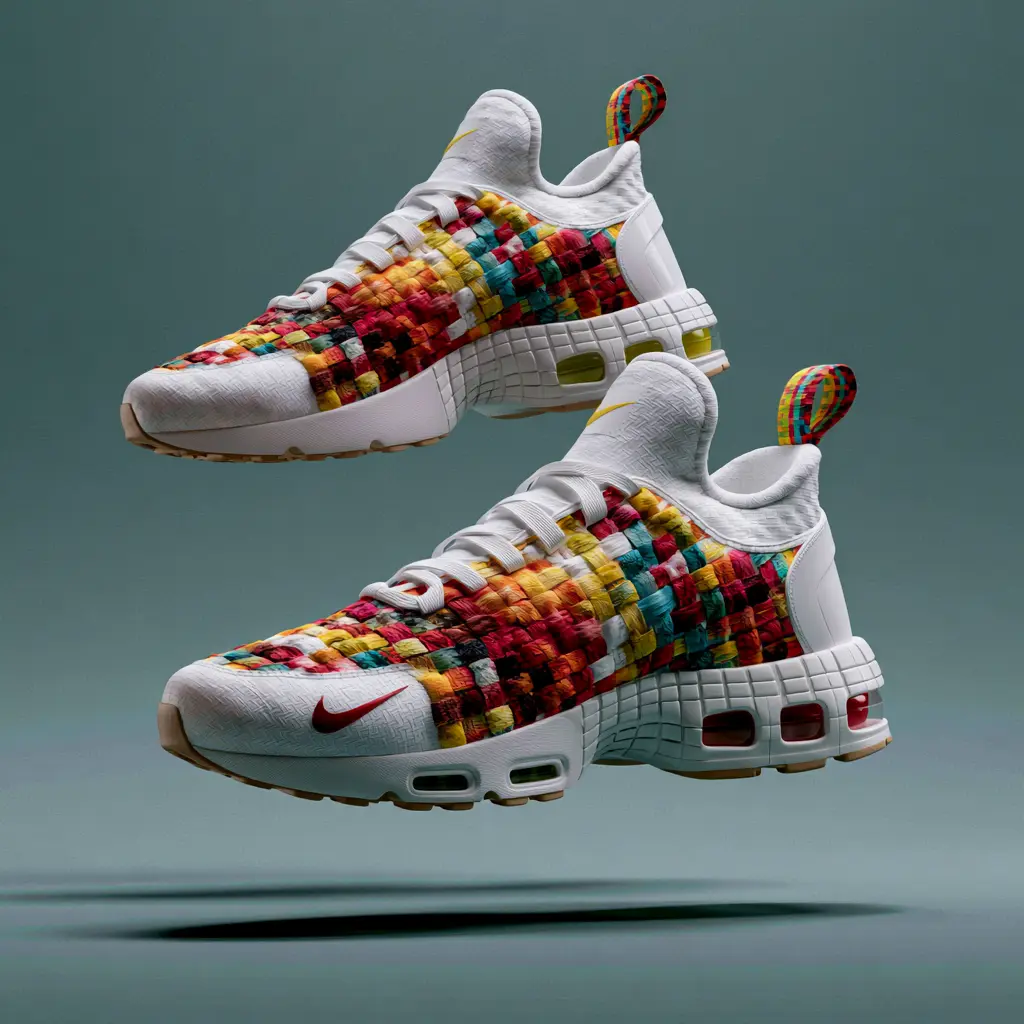
The Air Woven is the strangest of the three, and my personal favorite. Designed by Mike Aveni and reportedly inspired by nearly 10,000-year-old woven sandals discovered in an Oregon cave, the shoe’s entire upper is woven from nylon strands with no cutting, no sewing, and no traditional last involved in the process. It released first in Japan in 2000, then in New York and London, before Hiroshi Fujiwara revisited it in 2002 under the HTM label with a run of pixel-inspired “rainbow” colorways limited to 1,500 pairs each. One of those HTM pairs even made a quiet cameo on Bill Murray’s feet in Sofia Coppola’s “Lost in Translation” the following year.
Despite the cult following, the Woven has never commanded anything close to grail pricing, which is precisely the appeal. Sneaker Freaker’s deep dive into the Air Footscape and Woven lineage lays out just how influential the construction technique became for later Nike silhouettes, even as the original stayed a relatively affordable curiosity. Compare that to what I have written about in my look at the world’s rarest sneakers, and the gap between historical importance and market price on the Woven is almost comical.
A Few More Worth a Second Look
Those three are my deep cuts, but the early 2000s buried plenty of other shoes worth a second look if you are building out a collection on a budget. The Nike Shox BB4 and R4, with their visible spring-loaded columns, were the flashiest tech statement of 2000 and now read as pure, unpretentious nostalgia. The Nike Air Rift, with its split-toe design, still turns heads for how genuinely strange it looked next to anything else on shelves at the time. Neither commands serious money today, and both tell you something honest about how experimental sneaker design was allowed to get before everything got optimized for resale.
The Market Is Slowly Catching On
Part of why I am writing this down now is that the window on “undervalued” tends to close quietly and without warning. The sneaker resale market as a whole has grown from roughly $72 billion to a segment now pushing past $100 billion, and that kind of growth eventually pulls every era into the spotlight, not just the obvious grails. I have watched this happen before with shoes I once bought for pocket change. A few years of renewed attention from the right influencer or the right retro release, and a shoe that used to sit unsold in a resale bin suddenly triples in price overnight.
That is exactly why the early 2000s feels ripe right now. It sits close enough in memory that the people who wore these shoes the first time around have disposable income and nostalgia working in the same direction, but far enough removed that the hype cycle has not caught up yet. I would rather be early to that shift than chasing it after the fact, and if the last decade of sneaker collecting has taught me anything, it is that the shoes nobody is arguing about today are usually the ones worth the argument tomorrow.
Why I Chase Shoes Nobody Else Wants
I think a lot about why the hunt for an overlooked shoe feels different from the hunt for a hyped one, and most of it comes down to what actually drives collectors in the first place. I dug into that question more directly in my piece on the psychology of sneaker collecting, and the short version is this: grails satisfy status, but forgotten gems satisfy curiosity. Nobody is impressed that you own a pair of Considered Boots. You buy them because you already know the story is worth telling, which is a much better reason to collect anything.
It is the same instinct that had me digging through parts catalogs for an underrated Oldsmobile instead of chasing the muscle car everyone already agrees is great — I wrote about that hunt on my muscle car site if you want the four-wheeled version of this same argument. Underrated is underrated, whether it laces up or has a V8 in it.
What I Look For Before I Buy
When I am deciding whether an overlooked shoe is worth adding to the collection, I run it through the same three questions every time: does it represent a genuine design or technology milestone, not just an odd color; is the story behind it something I would actually want to explain to someone; and is the current price disconnected from that story in a way that will not last forever. The Jordan XVII, the Considered Boot, and the Air Woven all pass on every count. That is usually the signal that a shoe is a forgotten gem and not just forgotten.
I post more of these finds as I track them down on Pinterest, where I keep boards organized by era for anyone who wants to go down the same rabbit hole.