
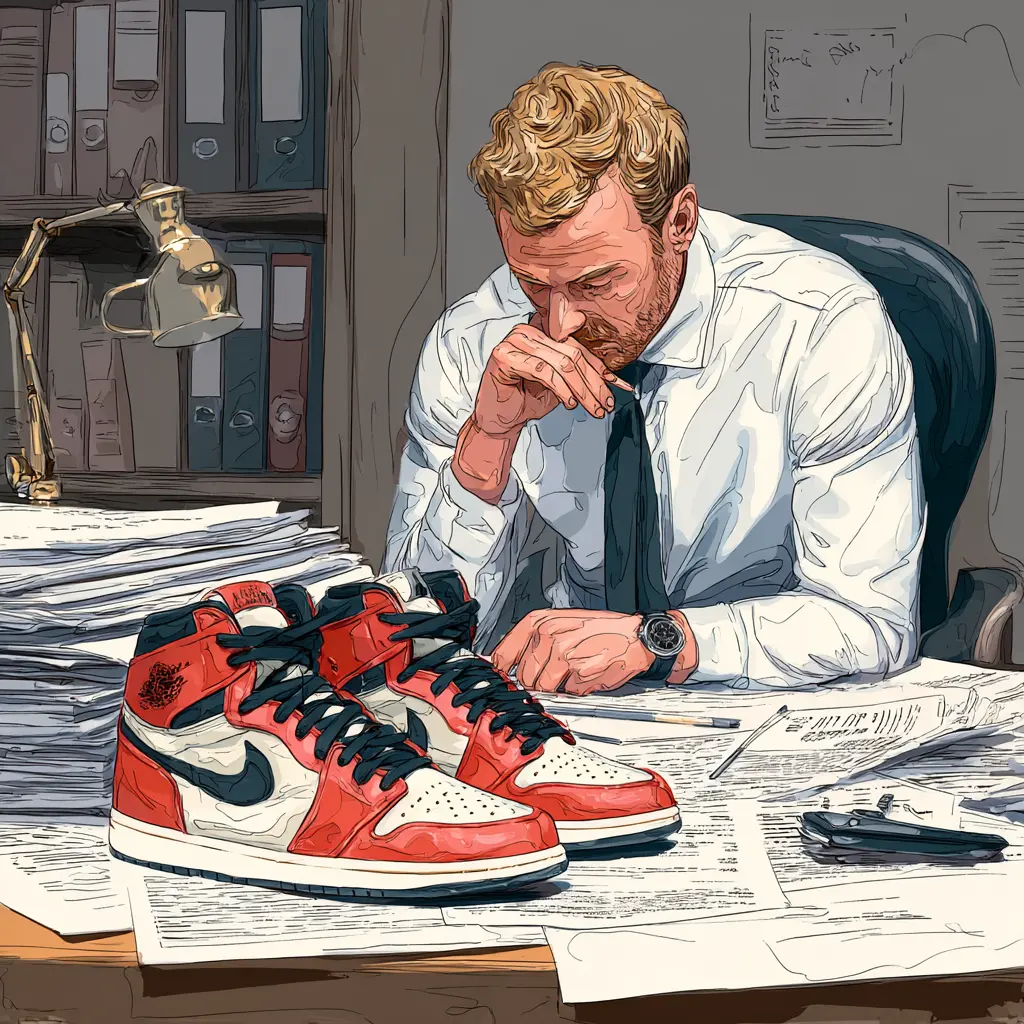
People sometimes raise an eyebrow when they discover that the same person who built a virtual accounting firm serving over 200,000 small businesses also maintains a meticulously catalogued collection of Air Jordan sneakers. What does a CPA have to do with a sneaker wall? As far as I’m concerned, everything.
The longer I spend on both sides of that equation — running a company and building my Air Jordan collection — the more I notice that the disciplines are nearly identical. The patience, the research, the cost management, the long view: the skills that make someone a sound business operator are precisely the skills that separate a serious sneaker collector from someone who just got lucky a few times on a resale app. This is the same focus and strategy that I bring to my collection of vintage LEGO sets. Let me walk you through exactly how I see it.
Due Diligence Before Every Acquisition
In business, you never sign a contract, hire an executive, or enter a new market without first doing your homework. You research the competitive landscape, you study comparable deals, you pressure-test the numbers. Smart sneaker collecting demands the same rigor.
Before I add any pair to my collections, I want to know its full history: the original retail price, the release year, the colorway name, the production volume, and what the secondary market has done with it over time. A limited release with a compelling backstory and a shrinking supply will behave very differently over five years than a general release that Nike restocks every holiday season. Understanding that difference is not instinct — it is research, and it requires the same analytical mindset I apply to evaluating a new market segment or a client’s balance sheet.
Platforms like GOAT now publish detailed price history charts for individual sneaker models and colorways. I treat those charts the same way I treat a company’s revenue trend line. If the slope is consistent and the trading volume is healthy, I have more confidence in the acquisition. If the price spiked once on hype and then collapsed, that tells me something important about sustainability.
Acquisition Cost and the Hidden Expenses Collectors Ignore
One of the most common mistakes I see among newer collectors is focusing exclusively on the purchase price while ignoring the total cost of ownership. This is the same error small business owners make when they price a service only to cover direct costs and forget about overhead.
When you acquire a grail pair, the sticker price is just the beginning. Total cost of ownership, a concept any accountant will recognize immediately, includes storage solutions such as UV-protective display cases, climate-controlled shelving, and insurance riders on your homeowner’s or renter’s policy. For a collection of any meaningful size, those ancillary costs add up faster than most people expect.
I maintain a simple spreadsheet — something I would recommend to any collector — that tracks every pair by acquisition date, purchase price, estimated current market value, storage cost allocation, and insurance cost. That document gives me an honest picture of what my collection is actually worth on a net basis at any given time, and it prevents the kind of self-delusion that comes from remembering only the wins.
Inventory Management: Knowing What You Own and Why
A business with poor inventory management bleeds money. It over-orders what it doesn’t need, loses track of what it has, and fails to capitalize on what it holds. Collections work the same way.
Every pair in my Air Jordan lineup has a reason for being there. I am not accumulating randomly. Some pairs anchor the collection because of their historical significance to the Jordan Brand itself. Others represent specific cultural moments. A few are simply beautiful objects that I wanted to live with. But I can articulate the rationale for each one, which means I can also make clear-eyed decisions about whether a pair still belongs or whether rotating it out makes sense.
This connects directly to a concept from my earlier analysis of sneaker collecting trends for 2026: the market is maturing, and collectors who built their inventory with intention are better positioned than those who chased every hype drop without a unifying strategy. Intention and documentation are inventory disciplines, whether you are running a warehouse or a sneaker room.
Market Timing and the Patience to Wait
Every experienced investor knows that timing the market perfectly is impossible, but timing it reasonably well is a learnable skill. The same is true in sneakers.
The window immediately after a major Nike or Jordan Brand release announcement is almost always the worst time to buy. Hype is at its peak, resale premiums are highest, and the supply picture is least clear. Experienced collectors, much like value investors, often wait. They let the initial frenzy subside, watch for market corrections when restocks arrive or when demand softens, and make their moves when the price-to-value relationship improves.
I have passed on pairs at launch that I eventually acquired six or twelve months later at meaningfully better prices. The discipline required to walk away from a shoe you want when the price is wrong is exactly the same discipline required to walk away from a business deal when the terms are wrong. Urgency is the enemy of good decision-making in both arenas.
Condition Grading: Valuation Is Everything
In financial accounting, the way you value an asset on paper has direct consequences for the health of a balance sheet. Overvalue your receivables, and you are lying to yourself and your stakeholders. The same principle applies to a sneaker collection.
Sneaker grading has become increasingly standardized over the last decade, with professional grading services assigning numerical scores based on box condition, sole yellowing, upper integrity, and original accessories. A pair graded at a 9.5 and a pair graded at an 8.0 of the same model can carry dramatically different market values. When I assess the most valuable sneakers in any given year, condition grade is always one of the primary variables, not an afterthought.
Collectors who are dishonest with themselves about condition — who mentally grade their own pairs higher than the market would — are carrying inflated assets on their personal ledger. That distortion leads to bad selling decisions, unrealistic insurance coverage, and a collection that does not perform the way the owner imagines it will.
Diversification Within a Theme
Smart portfolio construction in business and investing involves diversification: spreading risk across sectors, asset classes, and time horizons. A well-built sneaker collection does the same thing within its own universe.
My Jordan collection spans models from different eras, silhouettes, and cultural contexts. Some are high-value and relatively illiquid — the kind of pieces you hold for the long term. Others are more liquid, with active secondary markets where I could sell quickly if I chose to. Having that mix means I am not entirely dependent on any single model’s trajectory.
This philosophy applies even to collectors who are just starting out. Rather than concentrating everything in the most hyped silhouette of the moment, building across the Jordan model numbers — including older models that the broader market has temporarily forgotten — creates a more resilient collection. As I noted in my piece on what drives serious collectors versus casual ones, the collectors who last are those who develop a coherent strategy rather than chasing the next trend.
The Long Game and What It Teaches You About Yourself
The deepest parallel between building a business and building a collection is this: both reward people who think in decades, not quarters.
The Jordan Brand has been releasing signature footwear since 1985. The cultural gravity of Michael Jordan’s legacy shows no meaningful signs of fading — if anything, new generations of fans are discovering it through documentaries, social media, and ongoing Nike marketing at a rate that keeps demand healthy. Collecting within that ecosystem is, at its foundation, a bet on a cultural institution that has compounded in relevance for four decades.
That is a long-game mindset. It is the same mindset that led me to build 1-800 Accountant around the conviction that small businesses would always need accessible, affordable, high-quality accounting services — and that technology would eventually make it possible to deliver those services virtually at scale. You do not build something durable by optimizing for this month. You build it by identifying what will still matter in ten years and committing to that vision with patience and consistency.
Why This Matters for Any Collector Who Wants to Get Serious
I do not share any of this to suggest that sneaker collecting needs to feel like work or that every pair needs to justify itself on a spreadsheet. The joy of the hobby is real, and no accounting framework should drain the pleasure out of it. But I do believe that applying even a few of these business disciplines — due diligence before buying, honest condition assessment, total cost awareness, long-term thinking — will make any collector sharper, more intentional, and ultimately more satisfied with the collection they build.
The sneaker wall in my home in New Canaan is many things: a personal passion, a visual record of basketball and design history, and a point of daily aesthetic pleasure. But it is also, quietly, a portfolio — one that I manage with the same care and respect I bring to every other dimension of my financial and professional life. The accountant’s eye does not turn off when I leave the office. In this case, I am grateful for that.
About Mike Savage: Mike Savage is the CEO and sole shareholder of 1-800 Accountant, a virtual accounting firm headquartered in New Canaan, CT, that serves over 200,000 small businesses nationwide. He is a 2018 recipient of the Glassdoor Top CEOs award and a lifelong collector of Air Jordan sneakers, Lego sets, koi fish, and contemporary art. He and his wife Sandra co-founded the Savage-Rivera Foundation, which supports families in need in Honduras.