
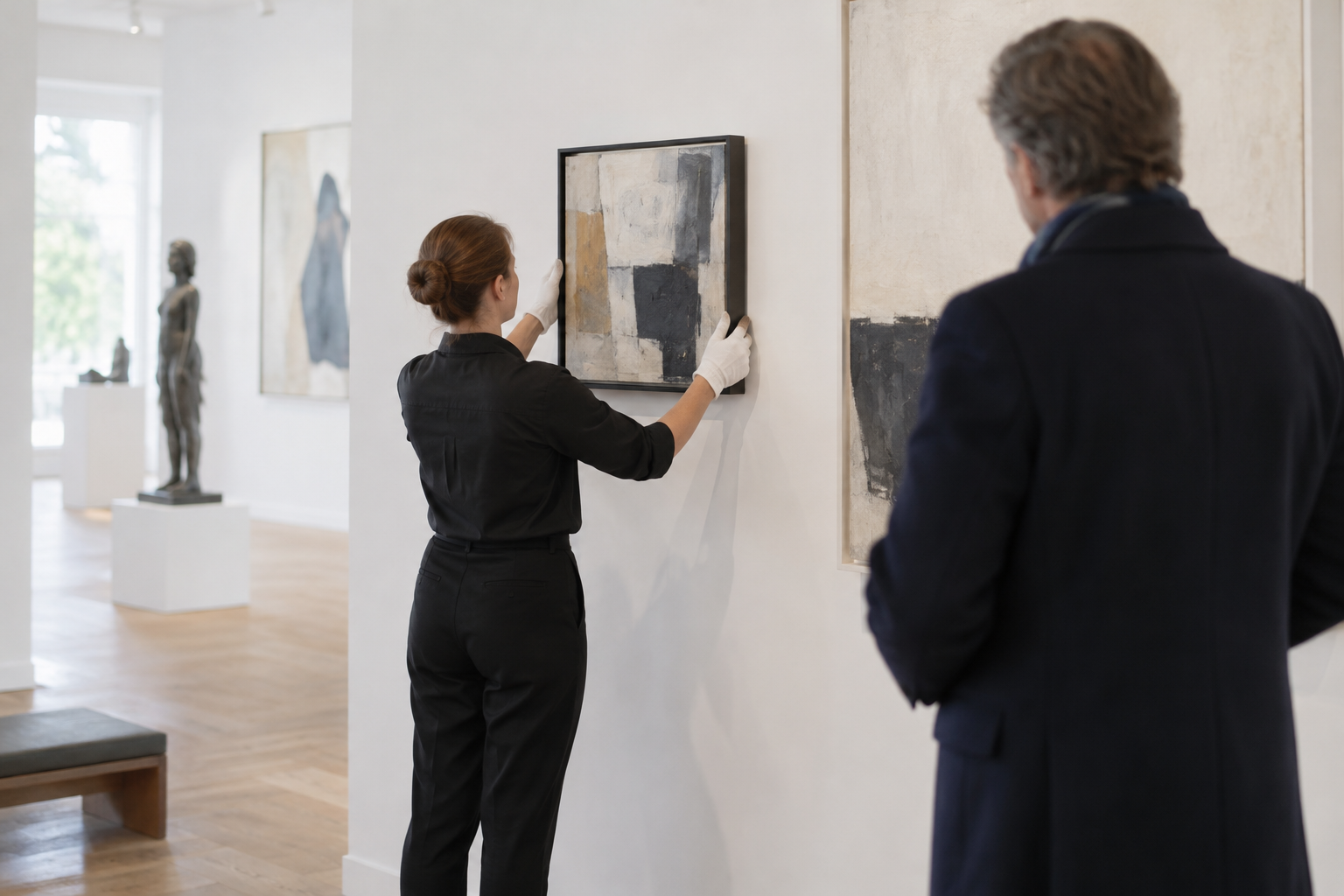
The first piece of art I ever bought that I did not strictly need, I bought standing in a small gallery I had ducked into to get out of the rain. I was in my twenties. I was there for ten minutes. I walked out having spent more than I had spent on anything that was not a car or a security deposit, and I remember the feeling precisely: a little sick, a little thrilled, and absolutely certain I would never get tired of looking at it. I was right about the last part.
People ask me about that moment more than they ask about anything else on this site. Not about the artists I have written up — Fran O’Neill, Amy Jorgensen, Michael John Kelly — but about the mechanics. How do you actually buy a piece of art? Where do you go? What do you say? How do you know you are not being taken? The question usually arrives in November, when people are thinking about gifts and year-end and the blank wall they have walked past for three years.
So here is the answer I give at dinner, written down. There are three front doors into the contemporary art market — the gallery, the art fair, and the artist’s own studio — and each one has its own rules, its own etiquette, and its own paperwork. I will take them in order, then tell you what an accountant looks for before the money leaves the account.
Start by looking, not buying
Before any of the three doors, spend a season just looking. Museums first, because nobody there is trying to sell you anything and you can find out what you actually respond to without a price tag in the corner of your eye. Then galleries, as many as you can walk into. Then the online programs of galleries in cities you will never visit.
You are trying to answer one question: what kind of work stops you? Not what you think you should like, not what a design magazine says is the moment, not what your college roommate collects. What makes you stand still. For me it turned out to be photography and abstraction, which surprised me — I had assumed I was a figurative-painting person. If you have read the Fringe Collectors post you know I have a lot of respect for people whose taste runs somewhere nobody else’s does. Your first piece should be the start of that, not a hedge against it.
The data backs this up more than you would expect. The Art Basel and UBS Survey of Global Collecting 2025 found that high-net-worth collectors attended an average of 48 art-related events in 2024 — exhibitions, fairs, studio visits — and planned to attend more in 2025. The people who buy well look a lot before they buy once.
Decide what the money is for
This is where the accountant in me takes over the conversation, and I make no apology for it. Before you walk into a gallery with intent, set a number. Not a range — a number, and it should be the number that lets you sleep. The art market is very good at making a figure feel reasonable in the room and unreasonable at the kitchen table.
Then add the costs that are not on the wall label. Framing, which on a work on paper can run a meaningful fraction of the price of the work. Shipping and crating, if it is not local. Sales tax. A rider on your homeowner’s policy once the piece crosses whatever threshold your insurer sets. If you buy at a fair in another city, the trip itself. I keep a line item called "acquisition costs" that sits next to the purchase price in my records, and it has never once been zero.
One more thing to settle before you go: are you buying a thing for a wall, or the first object in a collection? Both are fine. They just lead to different decisions. A wall purchase can be about scale and color and the room. A first collection purchase should be about the artist and the work, and the room will have to adapt. I have written elsewhere about how collecting Air Jordans is like running a business; the same applies here. Know what the asset is for before you acquire it.
Route one: the gallery
A gallery is the default door, and for a first buyer it is usually the right one. A primary-market dealer represents living artists directly, sets the prices in consultation with the artist, handles the paperwork, and has a professional reputation that depends on not selling you something misdescribed. The Art Dealers Association of America publishes a free Collectors’ Guide that walks through what dealers do, how to buy and sell through one, and what to expect at fairs and auctions. I would read it before your first serious visit. It is short and written for exactly the person you are.
A few things that are true about galleries and not obvious from outside:
- Prices are fixed and usually posted or available on request. You are not expected to haggle like a flea market. A courtesy discount of a few percent to a serious buyer is common; asking for a third off is not, and it tells the dealer something about you.
- Payment plans exist. Many galleries will split a purchase into installments for a buyer they want to keep. The work ships when it is paid off. You lose nothing by asking.
- Questions are welcome. Where did the artist train, who else has bought their work, has it been shown in a museum or written about, what is the edition size if it is a photograph or a print, has the price moved in the last two years and why. A good dealer wants to answer these. A dealer who gets vague is giving you information too.
- The relationship is the product. The piece you buy today is the least of what you are getting. The dealer who sells you a first work will call you when the next show opens, will put you on the list for something before it is public, and will tell you honestly when a work is not for you. That phone call is worth more than any discount.
My own first serious relationship with a gallery came out of exactly this. I bought something modest, I asked a lot of questions, I came back for the next opening without buying anything, and the third time I walked in the dealer said, "I have something in the back I think you should see." That sentence is the goal.
Route two: the art fair
Fairs are where the discovery happens, and the numbers say so: the Art Basel and UBS survey found that more than half of collectors made purchases connected to a fair in the last year. A fair is a few hundred galleries under one roof for four or five days, which means in an afternoon you can see more contemporary work than you could in a year of gallery-hopping.
That is the upside. The downside is that a fair is engineered to make you decide fast. Here is how I work one.
- Go twice. Walk the whole floor once without stopping to talk. Take photos of the wall labels for anything that stops you — the label has the gallery name, the artist, the title, the medium, and usually the price. Then go home, or at least to a coffee, and look at the photos. The things that still look good an hour later are the things to go back for.
- Ask for a hold, not a decision. If a piece is at the edge of your number and you are not sure, ask the gallery to hold it for you until the end of the day or the next morning. Most will, for a serious buyer. It converts a pressured decision into a considered one.
- The fair is the introduction; the gallery is the follow-up. You do not have to buy at the fair at all. The most useful thing I take home from a fair is a stack of cards from galleries whose programs I liked. The buying often happens three months later, by email, at a slower pace, with a condition report attached.
- Preview days are not magic. VIP previews get you first look, but for a first-time buyer the public days are fine and considerably calmer. The best works may be sold by then. So will the pressure.
One of the artists I have written about on this site, Amy Jorgensen, I first encountered in a fair booth — a single work in a group hang that I photographed, walked away from, and came back to. That is the pattern. The fair showed me the work. The gallery is where the conversation started.
Route three: the artist’s studio
The third door is the one that has opened widest in the last few years. The 2025 survey reported a notable rise in direct-from-artist purchases, both online and through studio visits, with collectors averaging seven studio visits a year and planning eight. Among people who bought from a gallery, 51 percent had made at least one purchase through Instagram. The line between "the gallery" and "the artist" is getting thinner, and a first-time buyer can walk through either.
A studio visit is the single best way to understand what you are buying. You see the work in the space it was made, you see what the artist is working on next, and you hear the thinking in the artist’s own words rather than a dealer’s paraphrase. When I visited Michael John Kelly, what I learned in two hours about how the paintings are built changed how I look at every one of them.
There are rules, and they are mostly about respect:
- Ask first, and ask through the right channel. If an artist is represented by a gallery, go through the gallery to arrange the visit. If they are not, a short, specific message — you saw this work, you would like to see more, here is who you are — is the right opening. Do not show up.
- Do not negotiate against the artist’s gallery. If an artist has representation, the gallery sets the price and the artist is expected to honor it. Asking an artist to sell you something cheaper on the side than the gallery would charge puts them in an impossible position. The right move is to buy at the gallery price and let the artist and the gallery sort out their split.
- Pay promptly and in full. An artist is not a gallery with cash flow. If you agree to buy, the money should move that week.
- Ask for the same paperwork you would get from a gallery. An invoice, a signed certificate, a title and date and medium and dimensions in writing. A serious artist will have this ready. Many will appreciate that you asked.
- Buy or do not buy; do not browse indefinitely. A studio visit costs the artist a working afternoon. If the work is not for you, say so kindly and thank them. If it is, say that too.
The paperwork an accountant actually reads
I spent my career at 1-800Accountant looking at other people’s records, and I will tell you that art purchases are where otherwise meticulous people go blank. They have the painting. They do not have the invoice. Here is the file I keep for every piece, and what each document is for.
- The invoice. Seller, buyer, date, price, the work described fully — artist, title, year, medium, dimensions, edition number if any. This is the document that proves you own it, and the document your estate will need.
- The certificate of authenticity, signed by the artist or the gallery, for anything editioned or anything where the artist’s hand is in question — photographs, prints, sculpture produced by a fabricator. For a unique painting bought directly from the artist, the invoice signed by the artist does the job.
- The condition report, especially for a work on paper or anything that has been shown before. A sentence from the gallery describing the condition at sale is enough. It is the baseline for every insurance conversation you will ever have.
- The provenance, which for a primary-market purchase is one line: from the artist, via the gallery, to you. Keep that line. The second owner will want it, and so will the fifth.
- A note on what you did not buy. You own the object; the artist still owns the copyright. That means you can hang it, sell it, lend it, and photograph it for your own records, but you cannot reproduce it on a greeting card or license the image without the artist’s permission. Springboard for the Arts has a clear fact sheet on this, and every first-time buyer should read it once so they are never surprised.
Then the piece goes into the same stewardship system as everything else I own. I wrote last month about why disclosure and records matter when a sneaker has been restored; the logic for a painting is identical. The record is part of the object. Keep it like you mean it.
Five mistakes first-time buyers make
- Buying to match the sofa. The sofa will be gone in six years. The painting will not. Buy the work; let the room adjust.
- Buying the name instead of the work. An artist’s reputation is useful context, not a reason. If you do not love this specific piece, the name on the label will not make you love it later.
- Waiting for the perfect first piece. There is no perfect first piece. There is the piece that teaches you what you want the second one to be. Start.
- Forgetting the costs around the price. Framing, shipping, tax, insurance. Budget the whole number, not the wall label.
- Buying unseen with no recourse. Online purchases are normal now — half the market is doing it — but a first purchase from a seller you cannot verify, with no return window and no paperwork, is how people get burned. Buy online from galleries with a physical address and a reputation to protect.
Why this matters to me
I am an accountant by training and a collector by temperament, and for most of my life I kept those two things in separate rooms. Writing this site has taught me they are the same room. The instinct that made me good at my business — look carefully, understand what the asset is before you buy it, keep the records, build relationships that outlast any single transaction — is exactly the instinct that makes a collection worth having. I have made the same argument about LEGO and the entrepreneurial mind over on my main site, and about muscle cars as alternative investments. It holds up every time.
Buying from living artists also matters to me for a reason that has nothing to do with investment. Every primary-market purchase is a direct transfer of money from someone who has it to someone who makes things. That is patronage in its oldest and simplest form. My wife Sandra and I started the Savage-Rivera Foundation because we believe in getting resources to the people doing the work on the ground in Honduras rather than to layers in between. Buying a painting from the person who painted it is a small version of the same belief.
And the looking never stops. On the travel blog I write about the galleries and museums Sandra and I seek out wherever we go, because every city has one room that will stop you if you let it. Back home in New Canaan it is the koi pond I stare at, and the garage I spend too much time in. Different objects, same habit of attention. The first piece of art you buy is where that habit starts.
Your first-purchase checklist
- Spend a season looking — museums, galleries, online programs — and find out what stops you.
- Set one number, including framing, shipping, tax, and insurance, and do not move it in the room.
- Read the ADAA Collectors’ Guide before your first serious gallery visit.
- Pick a door: gallery for a first purchase, fair for discovery, studio for understanding. You will use all three eventually.
- Ask questions. Training, exhibition history, edition size, price history. Vague answers are an answer.
- At a fair, walk twice, photograph the labels, and ask for a hold instead of deciding on the spot.
- At a studio, go through the gallery if there is one, never undercut it, and pay the week you agree.
- Collect the file: invoice, certificate, condition report, provenance line. Store it with the piece and a copy elsewhere.
- Remember you bought the object, not the copyright.
- Hang it. Look at it every day for a month. Then start thinking about the second one.
If you want to see the kinds of work that stop me — and the walls, booths, and studios I keep coming back to — I pin them on my Pinterest boards. Follow along, and if you buy your first piece this winter, send me a picture. I would like to see what you chose.
About the author: Mike Savage of New Canaan, CEO of 1-800Accountant, founder of Savage-Rivera Foundation. Mike collects contemporary art and Air Jordan sneakers at Mike Savage New Canaan Collections, writes about muscle cars at mikesavagenewcanaan.com, and shares his travels at michaelsavagenewcanaan.com.