
An Appreciation by Mike Savage of New Canaan, CT
There are artists who paint what they see, and then there are artists who paint what exists between consciousness and dreams, between the physical world and something far more elusive. Farrar Hood Cusomato belongs firmly to the latter category, and her work has captivated me since I first encountered her luminous oil paintings at Cumberland Gallery in Nashville.
As someone who has spent years building a diverse art collection that spans the kinetic energy of Ushio Shinohara’s boxing paintings to the quiet contemplation of contemporary photography, I find Hood’s work occupies a singular space—one that rewards prolonged viewing and invites the kind of meditation that our fast-paced world so desperately needs.
A Nashville Native with New York Refinement
Farrar Hood Cusomato was born into artistry. As the daughter of Pulitzer Prize-winning photographer Robin Hood, she grew up with a camera’s eye for composition and light. She speaks of following her father on photo assignments as a child, those formative experiences building what she calls a “visual language” from a very early age. This heritage is evident in every canvas—the precision of her compositions, the way light falls across her subjects, the careful attention to the interplay of shadow and illumination.
After earning her Bachelor of Arts in Fine Arts from the University of the South in Sewanee, Tennessee, Hood made the pilgrimage that so many serious American artists undertake—she moved to New York City. There, at the prestigious Pratt Institute in Brooklyn, she earned both a Master of Fine Arts in painting and a Master’s degree in Art History and Design—a dual accomplishment that speaks to her intellectual rigor and commitment to understanding her craft within the broader context of artistic tradition.
Hood herself notes that graduate school “forced me to home in on my intention with paint.” Before Pratt, her work was primarily portrait-based. The rigorous environment of one of America’s finest art institutions pushed her toward something more profound—a style that merges technical virtuosity with psychological depth.
The Sleeping Women: Exploring the Unconscious
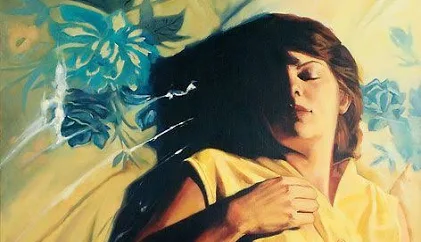
For much of her career, Hood’s signature subject has been the sleeping woman. These are not passive images of rest; rather, they are charged compositions that capture subjects in states of profound unconsciousness. Her women twist their hands as if struggling against unseen forces, contort their bodies into positions that suggest both vulnerability and resistance. They inhabit dream worlds dislocated from the viewer’s experience, yet somehow achingly familiar.
One of her most striking works from this period, “Rising Cool Settling Warmth,” depicts Hood’s own sister asleep on a floral chair balanced precariously between floor and wall. The subject appears so lost in sleep that she has been swept up and transported—the sensation of movement permeating every element of the arrangement. The intricate diamond wallpaper pattern, drawn from Hood’s childhood bedroom, creates a dual reality that she describes as both “protective enclosure” and “constrictive net.” This ability to hold contradictions in tension—comfort and anxiety, safety and threat—is what makes Hood’s work so compelling.
I find this exploration of liminal states fascinating, particularly when compared to other artists in my collection who work with similar themes of consciousness and perception. Like the work of photographer David Maisel, whose aerial perspectives reveal hidden patterns in landscape, Hood’s paintings uncover the hidden architecture of the psyche.
Technical Mastery: Oil on Wood Panel
Hood works primarily in oil on wood panel, a traditional medium that allows for the luminous, layered effects that characterize her paintings. The choice of wood panel over canvas is significant—it provides a smoother, more rigid surface that enables the minute detail and precise brushwork for which she is known. Her paintings are infused with artificial light executed in meticulous detail, the result of a process that begins with carefully staged photographs of props, backdrops, and models.
This methodical approach—inheriting her father’s photographic precision while transcending it through paint—creates works that feel both immediate and timeless. There’s a quality to Hood’s surfaces that rewards close inspection, revealing layers of meaning that emerge only through sustained attention. In this way, her paintings share something with the contemplative abstraction of artists like Todd Chilton, whose work similarly demands patient viewing.
Recent Evolution: Awakening and Nature
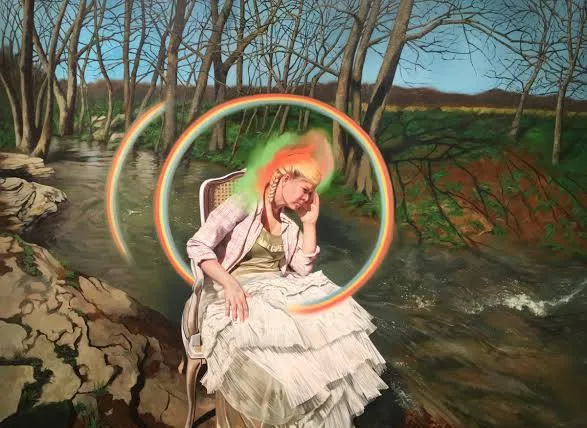
Since returning to Nashville and establishing herself as a senior lecturer at Vanderbilt University, Hood’s work has evolved in fascinating new directions. Her more recent paintings present figures and animals in naturalistic settings, exploring what she describes as “the notion of balancing multiple worlds of experience while navigating time and temporality.”
Fabric, quilts, and other traditional crafted artworks with elements of pattern and design now appear as subjects, coalescing with natural elements to symbolize psychological states, awareness, and femininity. For Hood, the natural world serves as “a bridge between physical reality and a parallel spiritual world that is always present, but most often exists beyond the visible.”
Her transition from sleeping to waking subjects marks a personal evolution as well. Hood has spoken of now painting “women who are active, awake, moving toward something”—figures that represent “struggle and changing patterns in life—moving out of one state and into a higher conscious state.” These newer works echo Hood’s own journey, both aesthetic and geographic, as she returned to her roots in Tennessee after her formative years in New York.
Shaping the Next Generation
Beyond her studio practice, Hood has made significant contributions to arts education. As a senior lecturer at Vanderbilt University’s Department of Art, she teaches Drawing and Composition, Painting, and Life Drawing—passing on the technical foundations and conceptual rigor that have defined her own practice. Her involvement in significant exhibitions, including participation in the prestigious 13th Havana Biennial alongside fellow Vanderbilt faculty, demonstrates her standing in the international art community.
This commitment to education resonates with my own belief that art collecting carries a responsibility beyond personal enjoyment. Just as Hood nurtures emerging artists at Vanderbilt, collectors have a role to play in supporting and championing the work of artists who are pushing their medium forward. It’s why I’ve documented my appreciation for contemporary artists like Mariah Robertson and Stefan Hagen—artists whose innovative approaches deserve wider recognition.
Where to Experience Hood’s Work
For those interested in experiencing Farrar Hood Cusomato’s paintings firsthand, she is represented by Cumberland Gallery in Nashville, Tennessee—one of the region’s most respected venues for contemporary art. Her work has been exhibited nationally in both group and solo exhibitions, from Space 204 at Vanderbilt’s E. Bronson Ingram Studio Art Center to the S. Tucker Cooke Gallery at UNC Asheville.
Works like “Signs & Symbols” (oil on wood panel, 48 x 36 inches, 2015) and “Night Vision” (oil on wood panel, 24 x 24 inches, 2017) showcase her current direction—paintings that hold nature and symbolism in delicate balance, inviting viewers into the liminal spaces between waking and dreaming, between the seen world and the felt one.
A Collector’s Reflection
What draws me to Farrar Hood Cusomato’s work, ultimately, is its refusal to be easily categorized. She is neither purely representational nor abstract, neither strictly traditional nor entirely contemporary. Her paintings exist in productive tension—between photography and painting, between sleep and waking, between the physical world and the spiritual realm she believes lies just beyond our perception.
In a world that increasingly demands quick consumption and instant gratification, Hood creates work that insists on slowness, on contemplation, on the kind of sustained attention that allows meaning to emerge gradually.
As I’ve written about my appreciation for artists across various media—from the dynamic energy of Ushio Shinohara’s boxing paintings to the quiet precision of contemporary photography—Hood’s work represents something essential: the power of painting to reveal what lies beneath the surface of our everyday experience.
For serious collectors interested in contemporary Southern art, Farrar Hood Cusomato is an artist whose work merits careful attention. Her technical mastery, conceptual depth, and ongoing evolution make her paintings not just beautiful objects but gateways to the kind of reflection that enriches our understanding of ourselves and our world.
— Mike Savage is an art collector based in New Canaan, Connecticut, whose collections include works by Ushio Shinohara and over 40 notable contemporary artists. Learn more about his collections at mikesavagenewcanaancollections.com.