

By Mike Savage of New Canaan, CT | mikesavagenewcanaancollections.com
Last month I spent a fair amount of time in this space talking about sneakers — about early-2000s models the market forgot, and what happens when a collector pays attention to something before the rest of the world catches up. That habit of looking closely at what other people walk past applies just as much to art as it does to footwear, and this month I want to point it at an artist whose work has occupied me for a long time now: Amy Jorgensen.
I’ll say up front that Jorgensen is not the easiest artist to summarize at a dinner party. She is a photographer who often works without a camera. She is a performance artist whose performances mostly happen with nobody watching. She is a curator who runs one of the most interesting contemporary art programs in the United States out of a stone granary in a Utah town of about seven thousand people. And she makes objects — blue-printed handkerchiefs, bruised paper, four-channel video of exploding fruit — that are so quiet in the room and so loud in the mind that I’ve watched people walk past them, stop, and come back.
That’s the reaction I look for. It’s the same one I described when I wrote about Ushio Shinohara’s boxing paintings — the sense that a work is not sitting politely on the wall but doing something to the space around it. Jorgensen gets there by an almost opposite route. Shinohara arrives with a roar. Jorgensen arrives as a whisper you can’t stop hearing.
A Childhood Between Milan and the High Plains Desert
Jorgensen was born in Milan, Italy, and finished high school in Utah — a biography that starts with a continental jump and never quite settles into one place. She has described a childhood home so full of art that her friends teased her about living in a museum, which is the kind of detail that explains a great deal about an artist without explaining anything at all. Plenty of kids grow up surrounded by paintings. Very few of them can name the one that got in.
Hers was a painting of a dark winter forest with a single blob of white paint in it, which she has called a kind of visual lifeboat. I find that image almost unbearably useful as a key to everything she has made since. A dense dark field. One bright mark. The eye going straight to the mark and holding on. Look at her suffragette cyanotypes, or the ghostly imprints of her Body Archive prints, and you are looking at the same structure: a saturated field, and one small piece of stubborn evidence refusing to disappear into it.
She earned her BFA from the School of the Museum of Fine Arts, Boston and Tufts University, and went on to an MFA at the University of California San Diego. On paper that reads like a clean, conventional ascent through two serious programs. In practice, by her own account, graduate school was where the whole thing nearly came apart.
“Well-behaved woman,” series photographed by Amy Jorgensen
The Crisis That Made the Work
During her MFA years, Jorgensen was doing three jobs at once. She was working for the conceptual artist John Baldessari — one of the towering figures of postwar American art, a man who famously cremated his own early paintings. She was shooting a Miller Lite advertising campaign. And she was trying to make her own work.
Consider that combination for a second. Conceptual art at its most rigorous on one side, beer commercials on the other, and a young artist in the middle trying to figure out which of those two things she was. That collision produced an existential crisis, and the crisis produced the work.
What pulled her out of it was research — specifically, into nineteenth-century photography’s least decorative corners. She went deep into early crime photography and into the Burns Archive, a legendary private collection of historical medical and pathology images. The photograph that changed everything for her was an 1891 image known as “Paisley Woman,” in which disease itself had written across a woman’s skin. Jorgensen looked at that and arrived at the idea that has organized her career ever since: the body as an independent author. The body as mark maker.
I want to sit on that phrase, because it’s the hinge. Photography spends most of its history as an act of pointing — a photographer stands here, aims there, and decides what counts. Jorgensen’s insight was that the skin has been recording the whole time, without being aimed at anything, and that those recordings are photographs too. As she has put it: her body is an archive, her skin the surface through which she experiences the world.
Body Archive: Photographs Made Without a Camera
The breakthrough itself came, of all places, out of a dream. She woke up, she has said, with the conviction that there was truth in her armpit — and immediately began putting light-sensitive emulsion directly onto her own body.
That’s Body Archive, begun around 2000 and still ongoing more than two decades later. There is no lens. There is no viewfinder. Photosensitive material is affixed to the body, and what registers is sweat, heat, pressure, hair, oil, contact, and time. The results are not pictures of a body; they are pictures by a body. Jorgensen has pointed out that with no viewfinder, there’s no mechanism for editing what gets in. Nothing is composed. Nothing is flattered. The image is evidence of an occurrence.
It’s also, deliberately, a reclamation. The female body in the history of Western art is overwhelmingly a body that has been looked at, arranged, and authored by someone else. Body Archive hands the authorship back to the body itself. Her 2006 exhibition of the series, The Body Archive: Residual Evidence, put those cameraless traces at large scale — a decision that reads to me as pointed. The work is faint by nature, and she refused to let it be small.
For collectors who have followed my writing on Mariah Robertson’s chemical, chance-driven camera-free photographs, there’s a natural rhyme here. Both artists let the process author the picture. But Robertson’s abandon is exuberant and chromatic; Jorgensen’s is forensic. One makes fireworks. The other makes a case file.
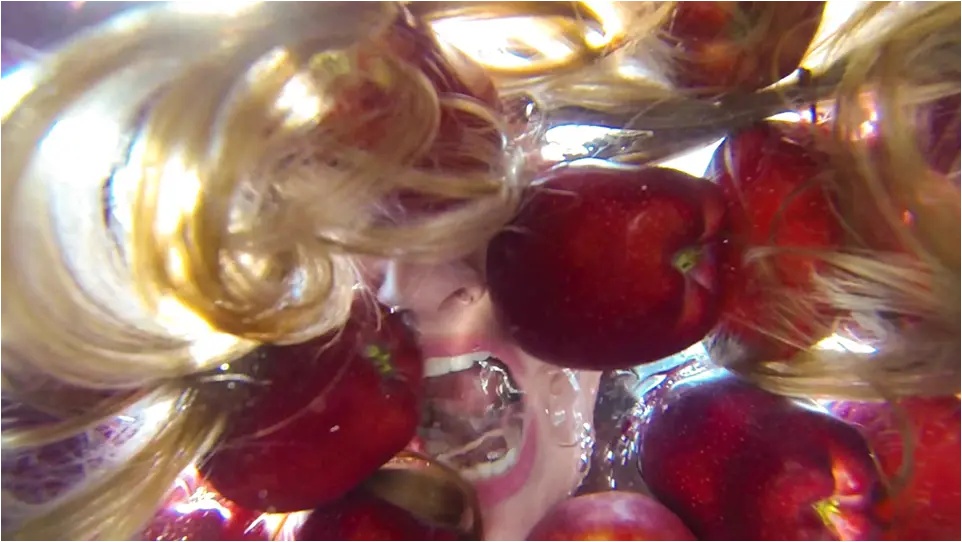
An inspiring photograph from Amy Jorgensen’s “Far From the Tree” photo series.
The Apple Works: Violence Aimed at a Symbol
Around 2014, Jorgensen turned her attention to the single most overloaded object in American visual culture: the apple. Temptation, health, teachers, Eden, Americana, New York, femininity. She decided to attack it — literally.
The Utah Museum of Contemporary Art presented Far From the Tree from October 17 to December 6, 2014, and the pieces in it are hard to shake. The title work is video shot from inside a barrel of water full of red apples, as the artist repeatedly plunges her head under. What begins as a nostalgic county-fair game — apple bobbing — becomes, through sound alone, something else entirely: splashing, gasping, the echo of a confined space. Drowning. Waterboarding.
An Apple A Day is a thirty-day documented performance in which she bit an apple, destroyed it with a sledgehammer, and let it rot, shot in a deliberately low-fi style that mimicked the hostage videos then circulating in the news. Apple of My Eye is a four-channel loop set in a desert that looks lifted from a Western, in which she shoots apples out of the air with military-grade .45 caliber pistols.
There’s a strategy running underneath all of it. Jorgensen has said she keeps returning to the apple precisely because it’s such a loaded stand-in for femininity — and then destroys it using the vocabulary of male power: the gun, the sledgehammer, the interrogation room. She isn’t reclaiming the symbol. She’s demonstrating what the culture has always been prepared to do to it.
That desert, incidentally, is not a set. It’s where she lives. Anyone who’s read my piece on David Maisel’s aerial photographs of a scarred American West knows how much that landscape can carry once an artist stops treating it as scenery.
Something Old, Something New: The Suffragette Cyanotypes
If you only ever see one Jorgensen work in person, I hope it’s from this series.
While researching her own family history — and specifically a great-aunt, Edna Berg, who campaigned for women’s rights in the early twentieth century — Jorgensen came across a set of photographs that had been unearthed from the British national archive in 2003. They were Scotland Yard surveillance images: covert shots of militant suffragettes, many taken while the women were imprisoned at Holloway. These were women who had committed arson and vandalism in pursuit of the vote, photographed by the state in order to track them.
Jorgensen printed those surveillance portraits as cyanotypes — the early nineteenth-century process known for its intense cobalt blue, and the process used by Anna Atkins, generally credited as the first person to publish a book illustrated with photographs. Then she printed them not on paper but onto vintage handkerchiefs.
Her explanation of that choice is the best short statement of her whole practice I know of: the handkerchiefs were meticulously embroidered by the hands of women, and as objects they were worn close to the skin, often in the folds of underclothing. Surveillance photography is the state looking at a woman without permission. The handkerchief is the most intimate, most private, most hand-made thing that woman owned. Jorgensen fused them.
The title comes from the wedding rhyme, which sets up the second collision: the suffragette movement and the marriage ceremony, two places where women’s autonomy has been argued over, laid on top of each other. Elizabeth Houston Gallery in New York showed eighteen of these blue portraits from February 8 to March 18, 2017, and the room was, by every account I’ve read, very quiet.
There’s a companion video piece, Well Behaved Women, in which two phrases run against each other on two channels — “the rain in Spain stays mainly in the plain,” spoken loudly, and “well behaved women seldom make history,” whispered. Elocution versus intention. The public voice and the private one. Anyone who has ever sat in a meeting saying the acceptable thing while thinking the true one will recognize the sensation immediately.
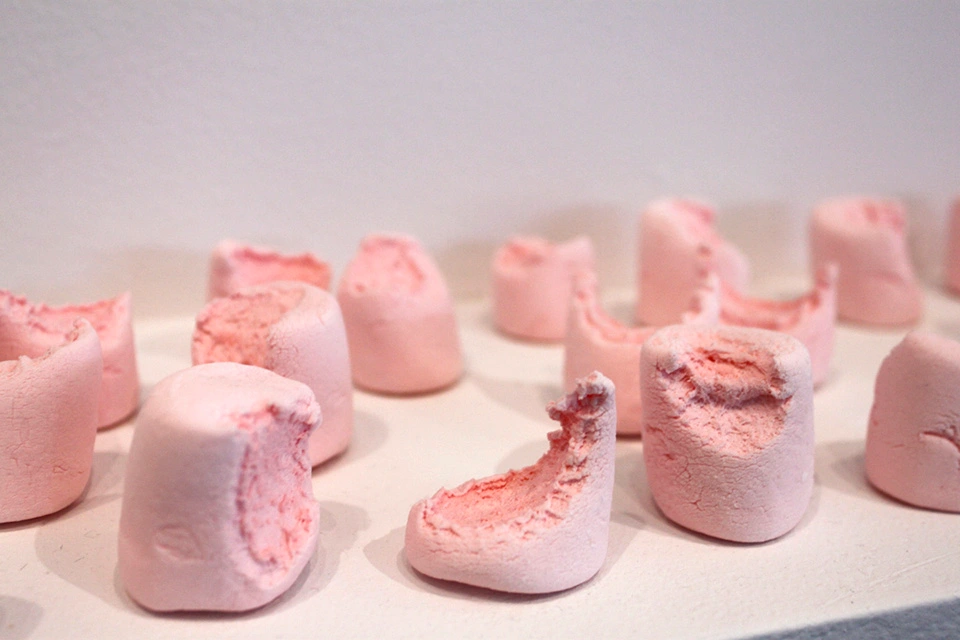
One image from the “Marshmallow Test” photo series by Amy Jorgensen.
Building the Room You Want to Stand In
Here’s the part of Jorgensen’s story that I, as a businessperson, find as compelling as any of the art.
She could have stayed in Boston, or San Diego, or New York. Instead she moved to Ephraim, Utah — population somewhere around seven thousand, in Sanpete County — for access to open space and proximity to family. She has taught at Snow College since 2005, where she built out the photography and media program, launched an Art Talks series, and created permanent student galleries essentially from nothing.
Then, in the fall of 2012, she went further. With fellow artist and Snow College colleague Kelly Brooks, she co-founded Granary Arts, a nonprofit contemporary art center housed in a granary built in 1876 by the Relief Society — the women’s organization of the Mormon community — and restored by artists in 1990. A building put up by women, restored by artists, now running international contemporary art programming in rural Utah. You could not invent a more fitting address for this particular artist.
Her line about it is one I’ve quoted to more than a few people since: in a rural place, you have to build the community you want to be a part of. In a city, she notes, everything is at your fingertips. In a rural space, you create the resources yourself.
And she did. Granary Arts has since presented dozens upon dozens of exhibitions under her direction as Executive Director and Chief Curator — she has curated well over ninety shows of contemporary artists — alongside a Fellows program, a Film Feast series, a curatorial workshop, and Critical Ground, an initiative aimed at democratizing art criticism by moving the conversation toward artists and communities working outside the New York–Los Angeles axis. She also led DE|MARCATION, a multi-year survey of contemporary photography in Utah that deliberately pushed back on the postcard version of the Western landscape. She serves on the Utah Arts Council, has received an Individual Artist Grant from it, and has been named among Utah’s most influential artists.
Jorgensen has been blunt about the economics underneath all of this, too — that a great deal of art labor is unrecognized, undervalued, and underpaid, and that the fix is participating in culture rather than merely consuming it. Active, not passive. As someone who has spent a career at 1-800Accountant looking at what it actually costs to keep a small enterprise alive, I’d say she’s describing an operating principle, not a complaint.
Why This Work Matters to Me
Collecting art, done right, is not about accumulation. It’s about paying attention early and then living with the consequences. I’ve made that argument about the surfaces and material intelligence in Michael John Kelly’s paintings and about the slow-burn mysteries in Stefan Hagen’s photographs, and it holds for Jorgensen more than almost anyone.
Her work asks a question I keep coming back to in every part of my life: what counts as evidence? A surveillance photograph counted as evidence to Scotland Yard. A handkerchief did not. A pathology photograph counted as evidence to a nineteenth-century physician. A woman’s own account of her body did not. Jorgensen spends her career flipping which of those two things we’re prepared to believe — and she does it with cobalt blue, cotton, sweat, and a sledgehammer.
That instinct isn’t confined to the art wall. It’s the same one behind the work my wife Sandra and I do through the Savage-Rivera Foundation in Honduras, where the families whose lives most need documenting are the ones least likely to appear in anyone’s official record. It’s in the LEGO builds and koi ponds I write about on my main site, where the value lives in patience rather than price tags, and it’s in the places I go and write up on my travel blog — where what I remember is almost never what was on the itinerary.
If you’d like to see the pieces I keep photographing and the work that’s caught my eye lately, I post a fair amount of it over on my Instagram.
Go find a Jorgensen in person if you can. Stand in front of one of those blue handkerchiefs long enough to register that you’re looking at a woman the government wanted tracked, printed on the most private object she owned, in a color invented in 1842. Then decide what you think evidence is.
Mike Savage of New Canaan, CEO of 1-800Accountant, founder of Savage-Rivera Foundation, collects contemporary art and writes about it here at Mike Savage New Canaan Collections.