
By Mike Savage of New Canaan, CEO of 1-800Accountant and founder of the Savage-Rivera Foundation
There are artists whose work you appreciate from a respectful distance — beautiful, accomplished, correctly hung on a wall and admired in the way you admire a well-made piece of furniture.
And then there are artists who get inside you.
Artists whose work doesn’t just occupy space but generates it, whose energy is so particular and so alive that standing in front of one of their pieces changes the quality of the room.
Ushio Shinohara is the second kind of artist.
I have been collecting art for years from my home in New Canaan, Connecticut, and I have encountered work across a wide range of styles, movements, and price points. What drew me to Shinohara — and what keeps drawing me back — is something that is genuinely difficult to name.
It is partly the visual intensity of the work.
It is partly the biographical arc of the man, which reads less like an artist’s career than like a force of nature moving through several decades of art history.
And it is partly something more personal: a recognition that the kind of commitment Shinohara has brought to his practice over more than six decades is the same kind of commitment that makes anything worthwhile.
This post is my attempt to give that recognition proper form.
Who Is Ushio Shinohara?
Ushio Shinohara was born in Tokyo in 1932. He emerged as a significant figure in the Japanese avant-garde scene of the late 1950s and early 1960s, a period of extraordinary creative ferment in Japan as artists processed the aftermath of World War II and the American occupation and searched for new forms that could carry the weight of that experience.
He became associated with the Neo-Dadaist Organizers, a Tokyo-based collective that staged provocative performances and exhibitions in direct challenge to the established art world. The Neo-Dada movement in Japan drew on Dada’s tradition of transgression and absurdity but inflected it with a specifically Japanese postwar sensibility — raw, irreverent, and intensely physical.
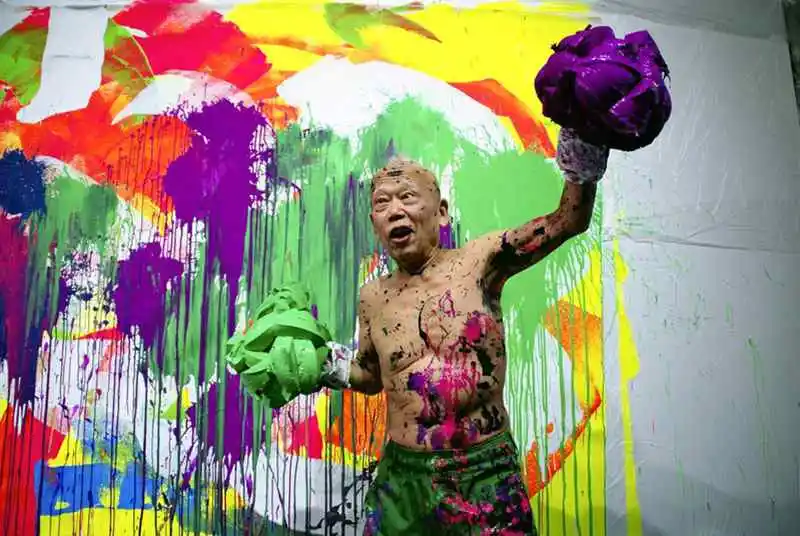
Shinohara’s contribution to this movement was unmistakable. Where other artists worked with found objects or performance gestures, Shinohara developed what became known as his “boxing paintings” — large-scale works created by dipping boxing gloves in paint and punching the canvas repeatedly, sometimes for hours, building up dense, explosive fields of color through pure physical force. The images that result are not abstract in any detached, intellectual sense. They are visceral records of an event. You are looking at the aftermath of a performance, at evidence of a body moving through space with enormous energy.
Shinohara moved to New York in 1969, and the city has been his home ever since. His life in New York — the downtown art scene, the loft in Tribeca he has shared for decades with his wife, the sculptor Noriko Shinohara — was documented in the acclaimed 2013 film Cutie and the Boxer, which received an Academy Award nomination for Best Documentary Feature and introduced a global audience to one of the most singular artistic partnerships in contemporary art.
The Boxing Paintings: Violence as Creation
It is impossible to write about Ushio Shinohara without spending serious time on the boxing paintings, because they are unlike anything else in the history of art and because they contain the essence of what makes his work so compelling.
The process is simple to describe and almost incomprehensible to witness. Shinohara dons oversized boxing gloves, loads them with paint, and attacks the canvas. He is not sketching or composing in any conventional sense. He is moving. The gesture is the whole thing — the force of the punch, the spread of the paint on impact, the rhythm of repeated strikes building a surface that is dense with energy and entirely unpredictable in its specifics.
What comes out of this process defies easy categorization. The works are simultaneously abstract and documentary. They are records of a physical event — you can read the force of individual punches in the way the paint has spread, the direction of the impact, the density of the accumulation. But they are also images of extraordinary beauty, fields of color and texture that reward sustained looking in the way that the best abstract painting always does.
The art critic Robert Hughes once described the most vital abstract expressionist works as paintings that felt like something had happened in front of them. Shinohara’s boxing paintings take that idea literally. Something did happen. The painting is the record of it.
For collectors, the boxing paintings represent one of the most direct connections available between an artist’s physical presence and the object that hangs on the wall. When you own a Shinohara boxing painting, you own a record of the man’s body in motion. That is not metaphor. It is the literal fact of the work.
Motorcycle Sculptures and the Breadth of Shinohara’s Vision
The boxing paintings are the work most people encounter first, but they represent only one dimension of Shinohara’s practice. He has also produced an extraordinary body of sculptural work, most notably his motorcycle sculptures — large-scale, densely encrusted assemblages built from cardboard, paint, and found materials that replicate the form of motorcycles with an intensity that is almost hallucinatory.
The motorcycle sculptures began in the 1960s and have continued as an ongoing series throughout Shinohara’s career. They are not replicas in any conventional sense. They are transformations — the motorcycle form used as a vehicle for an accumulation of color and texture and found material that turns a familiar object into something entirely strange and entirely Shinohara’s.
The sculptures carry a specific energy that connects them to the boxing paintings even across the difference in medium. Both are about accumulation — the building up of layers, of marks, of physical presence, until the object becomes something beyond its origins. A boxing painting begins with canvas and paint. A motorcycle sculpture begins with cardboard and hardware store materials. What they share is the transformation wrought by Shinohara’s particular intensity of engagement with his materials.
Shinohara in the Context of Postwar Japanese Art
To fully appreciate what Shinohara has accomplished, it helps to understand the context in which his work developed. Postwar Japan was a society in profound transition — economically devastated by the war, culturally disoriented by the occupation, and searching for identity in the space between its own traditions and the Western modernity that the occupation had imposed.
Japanese art in this period produced some of the most radical work of the twentieth century. The Gutai group, based in Osaka, developed performance-based practices that anticipated much of what would later emerge in American Happenings and Fluxus. The Mono-ha movement explored the relationship between materials and space in ways that anticipated Arte Povera. And the Neo-Dada scene in Tokyo, from which Shinohara emerged, pushed transgression and physicality to their limits.
What distinguishes Shinohara from many of his contemporaries is the sustained coherence of his vision across more than six decades. He did not abandon the boxing paintings when they became recognized. He did not pivot to new media when the art market shifted. He continued — deepening, refining, exploring variations within a practice that has remained fundamentally consistent even as it has evolved.
The Smithsonian’s archives on postwar Japanese art offer a useful entry point for anyone who wants to understand the broader movement from which Shinohara emerged. The Smithsonian’s resources on Gutai and the Japanese avant-garde trace the connections between Gutai’s radical materialism and Shinohara’s boxing practice with clarity and depth.
Collecting Shinohara: What It Means to Own This Work
I want to speak directly about what it means to collect Shinohara’s work, because I think the collecting experience is itself part of what makes this artist significant.
When I first encountered a Shinohara boxing painting in person — not in reproduction, but in the actual physical presence of the work — what struck me was how completely the scale and texture of the piece defeated any preparation I had done looking at images. Reproductions of Shinohara’s work are interesting. The real thing is something else entirely. The physical density of the painted surface, the scale of the gestures, the way the work occupies space — none of this translates through a screen or a page.
This is true of a great deal of art, of course. But it is particularly true of Shinohara because the work is so fundamentally about physical process. You are not looking at an image in the conventional sense. You are looking at evidence of a physical event. And that evidence has a presence — a weight, a texture, a scale — that reproduction cannot convey.
For collectors who are considering Shinohara’s work, I would say the same thing I say about any significant acquisition: see it in person before you decide. The work demands to be experienced physically, and the experience of being in front of a Shinohara boxing painting will tell you more than any amount of research or criticism.
You can follow updates on new additions to the collection and thoughts on the art world from Mike Savage of New Canaan on Pinterest at pinterest.com/mikesavagenewcanaan, where images from the collection are shared regularly.
Cutie and the Boxer: Art, Marriage, and the Cost of a Life in Art
Any serious engagement with Shinohara’s work eventually encounters the 2013 documentary Cutie and the Boxer, directed by Zachary Heinzerling. The film follows Ushio and Noriko Shinohara over the course of a year in their Tribeca loft, documenting the textures of their life and work with extraordinary intimacy.
What makes the film remarkable is not the access it provides to Shinohara’s studio practice, though that access is significant. It is the portrait it offers of what a life fully committed to art actually looks like from the inside — the financial precariousness, the creative obsession, the complicated dynamic of two artists in a long marriage where one has historically received most of the recognition.
Noriko’s work — small, delicate paintings that narrate her own experience of the marriage and the art world with a wit and precision that is entirely her own — received renewed attention in the wake of the documentary, and rightly so. The film is not just about Ushio. It is about the ecosystem of a creative life, and about what it costs to sustain one over decades in a city as expensive and as competitive as New York.
For anyone who has not seen it, the documentary is essential viewing — not just for the insight it provides into Shinohara’s work but for what it says about art, commitment, and the particular kind of courage it takes to stay true to a vision over a long life.
Why Shinohara Matters Now
There is a tendency in the contemporary art market to valorize newness — new artists, new movements, new conceptual frameworks. The cycle turns quickly, and work that felt urgent a decade ago can feel dated almost overnight.
Shinohara’s work is immune to this dynamic, for a simple reason: it was never about being new. It was always about being true. The boxing paintings of the 1960s and the boxing paintings of the 2010s are recognizably the same practice — not because Shinohara has been repeating himself, but because he found something real and has stayed with it, deepening it over time in the way that only sustained commitment makes possible.
This is rare. In a culture that rewards novelty and pivots, an artist who has spent sixty years developing a single practice with absolute consistency is genuinely unusual. And the depth that accumulates through that consistency — the way the later works carry the weight of everything that came before them — is something that cannot be manufactured or accelerated.
For collectors, this consistency is also a form of security. The market for Shinohara’s work is built on a foundation of genuine critical recognition and a documentary record that extends back more than six decades. The Museum of Modern Art in New York holds Shinohara’s work in its permanent collection, a recognition of his significance that anchors the broader institutional case for his importance.
The Shinohara Collection and What Comes Next
My own engagement with Shinohara’s work has been one of the more rewarding aspects of my collecting life, and it has informed the way I think about collecting more broadly — about the difference between acquiring objects and building a relationship with an artist’s vision over time.
The full scope of what I collect — from Shinohara’s work to Air Jordan sneakers to other pieces that have found their way into the New Canaan house over the years — is documented at Mike Savage New Canaan Collections. If you are curious about the breadth of what drives a committed collector, that is where to look.
The humanitarian work that Sandra and I do through the Savage-Rivera Foundation exists in a different register entirely from the collecting life, but they are connected by the same underlying principle: that paying close attention to something — a work of art, a community in need, a person you love — is one of the most valuable things a human being can do.
And for a broader look at the travel and international experiences that have shaped both the collecting and the humanitarian work, the Michael Savage New Canaan Travel Blog traces some of those journeys in detail.
A Final Word
Ushio Shinohara is 93 years old and still working. That fact alone is worth sitting with for a moment.
A man who has been making art since the 1950s, who has survived poverty and obscurity and the grinding economics of a life committed to a vision that the market was slow to recognize, who has continued to punch canvases and build cardboard motorcycles and push the boundaries of what a committed physical practice can produce — and who is still at it.
There is something in that persistence that goes beyond art. It is a lesson in what commitment looks like across a life, and in what becomes possible when you refuse to stop.
Mike Savage of New Canaan, CEO of 1-800Accountant and founder of the Savage-Rivera Foundation, finds that lesson as relevant to business and to life as to art collecting.